Hummingbirds of the Andes Mountains

Last Updated on May 28, 2026 by Amylee Silva
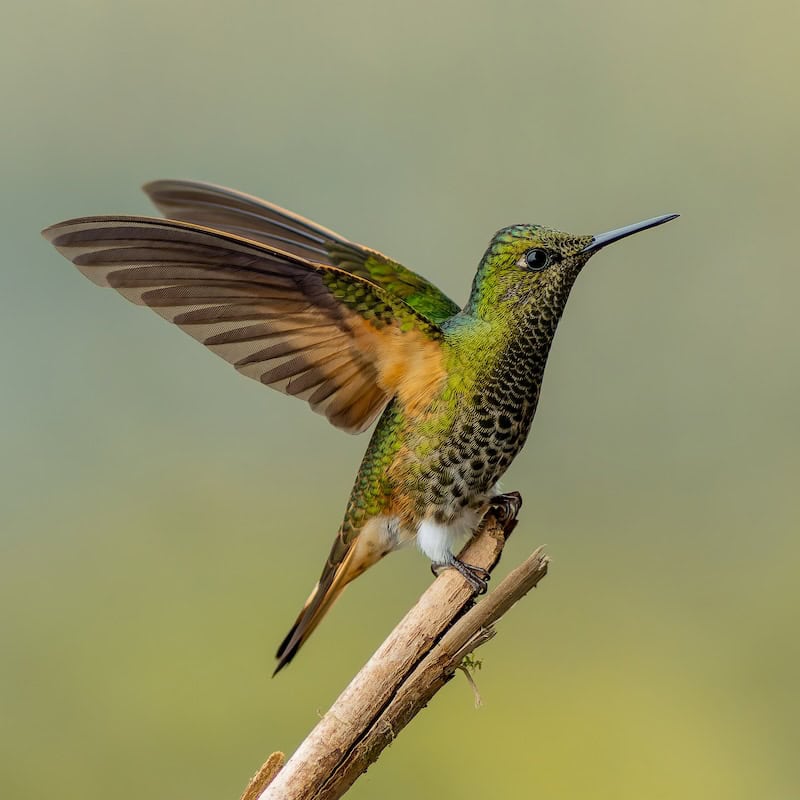
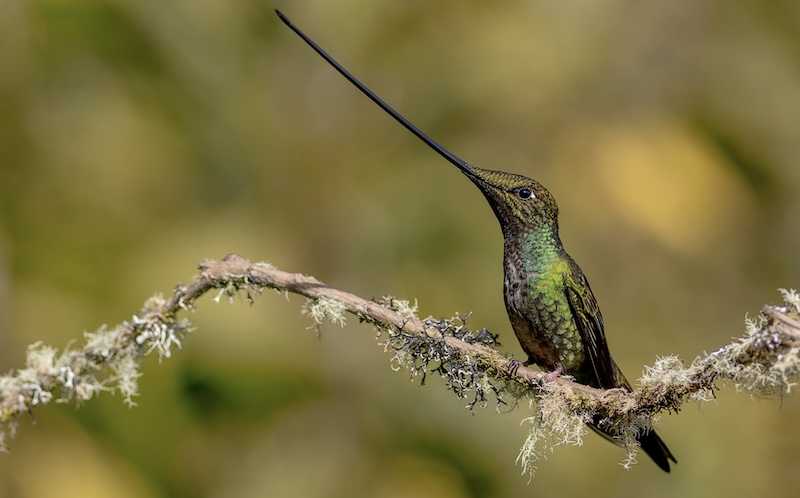
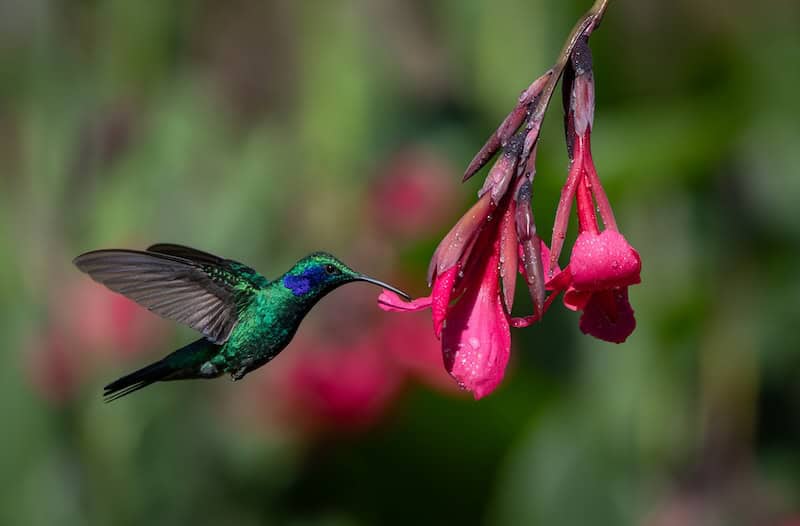
There’s a moment, early in any Andean birding expedition, when you realise the hummingbirds are everywhere. Not just at the hummingbird feeders strung up by lodge owners across South America’s most biodiverse mountain range, hoping to please their guests, but in the lush cloud forest canopy, hovering over roadside flowers at 3,000 metres, darting between epiphytes in the rain, perched in plain view on a mossy branch above a stream. You stop counting because counting seems beside the point. You start noticing instead: the particular shimmer of a Violet-tailed Sylph’s improbably long tail, the almost translucent blue of a Sparkling Violetear catching morning light, the architectural strangeness of a Sword-billed Hummingbird, the only bird on Earth with a bill longer than its body.
This is Ecuador’s Andes. And for these tiny bird species, there’s nowhere else quite like it.
The Numbers Behind the Wonder
Ecuador hosts over 132 species of hummingbird. That figure represents nearly 40 percent of all hummingbird species on Earth, concentrated inside a country roughly the size of Colorado. Of those 132 species, a significant proportion are found in the Andean montane forest region specifically, where altitudinal gradients compress extraordinary habitat diversity into relatively short distances; you can move from subtropical cloud forest to high páramo grassland in the course of a morning’s drive.
No other country comes close to this density. While Colombia edges ahead in raw species count, no nation offers the accessibility, the road network, the density of specialist birding lodges, and the sheer topographic variety that Ecuador provides. A single well-designed week can realistically yield more than 60 hummingbird species. A single exceptional morning at the right feeder station can produce twenty.
The reason for this concentration lies in geology as much as ecology. The Andes acted, over millions of years, as a species factory: isolated valleys, opposing slopes separated by high ridgelines, and the relentless pressure of altitude created conditions for speciation at remarkable speed. The result is a fauna where closely related species occupy distinct elevation bands, east and west slopes host different assemblages, and even the same mountain can harbour a dozen hummingbird species stacked vertically through its forest zones.
The Key Andean Species. Cloud Forest Icons.
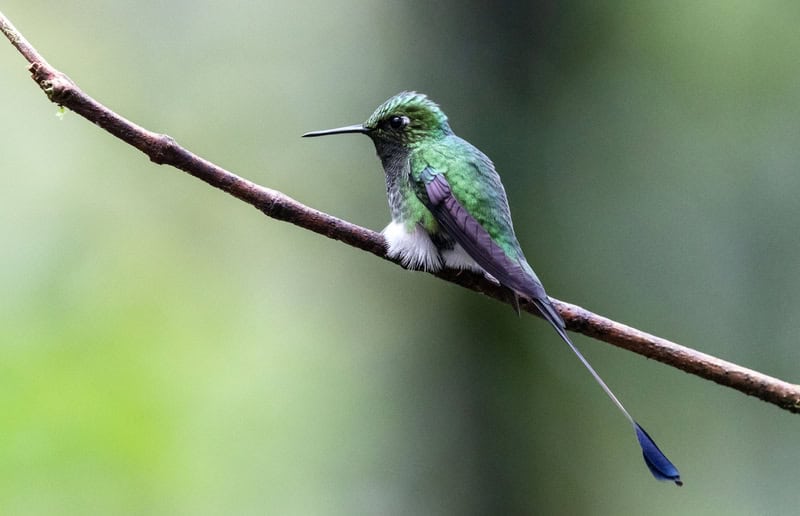
Booted Racket Tail (White-Booted Racket-tail)
Tail is among the most immediately recognisable Andean species: a compact green bird whose elongated outer tail feathers terminate in shimmering violet-black spatulas that seem to defy aerodynamic reason. It inhabits the western and eastern cloud forest slopes, typically between 1,200 and 2,100 metres (well above sea level), and is frequently encountered at feeders where it flares those remarkable tail ornaments in territorial display.
Violet-tailed Sylph
One of two sylph species whose long iridescent tails look almost identical to the untrained eye but occupy opposite Andean flanks — haunts the Tandayapa Valley’s western slope, a name that has become synonymous with high-quality cloud forest birding. The Long-tailed Sylph occupies the east. Both are among the most photographed birds in the country, and deservedly so.
Sword-billed Hummingbird
Found in temperate zones between approximately 2,500 and 3,500 metres, warrants a paragraph of its own simply because it has no parallel. Its bill is literally longer than its body — an evolutionary co-adaptation with the deep tubular flowers of the guanto plant — and watching it hover, tipping that outsized appendage towards a flower, is one of the genuinely surreal experiences Andean birding delivers.
High-Altitude Specialists
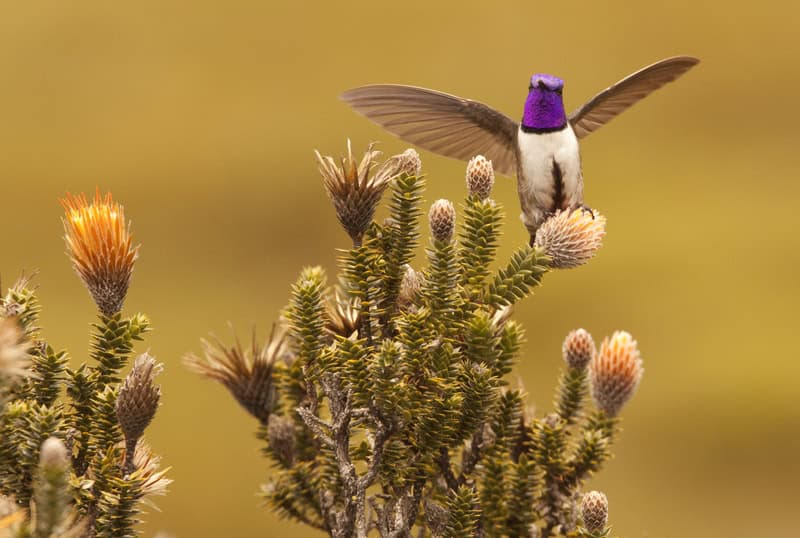
Above the treeline, in the cold, windswept páramo, a different suite of species takes over. The Ecuadorian Hillstar is among the hardiest, found at elevations pushing 5,000 metres, where freezing temperatures are the norm overnight rather than the exception.
Like several other high-altitude Andean hummingbirds, it survives the páramo nights by entering a state of torpor — slowing its heart rate dramatically and dropping its body temperature by around 25 degrees Celsius to save energy. During torpor, metabolism reduces by as much as 95%, allowing the bird to survive on fat reserves that would otherwise be exhausted within hours.
On cold nights when temperatures plunge well below zero, groups of Hillstars have been observed sharing a single cave roost, setting aside their otherwise territorial behaviour to conserve warmth. In the morning, they revive and resume foraging as though nothing unusual had happened.
The Great Sapphirewing, one of the largest hummingbirds in the world, patrols the higher cloud forest edge and páramo borders, its deep blue-green feathers appearing almost black until it catches direct light. The critically endangered Black-breasted Puffleg, found nowhere on Earth except certain high-elevation sites in Ecuador, represents the stakes of this landscape: a species of singular beauty on the edge of existence, dependent on the continued integrity of its Andean habitat.
The Chocó Corridor
The western slope of the Andes, where the mountains descend towards the Pacific lowlands, forms part of the Chocó bioregion — one of the most endemic-rich areas on the planet. Hummingbirds here include the Gorgeted Sunangel on the lower slopes, where dense flowering shrubs line the forest edge and provide reliable nectar year-round — alongside species that do not occur on the Amazonian side at all. The Andes as a physical barrier is not incidental to this diversity; it is its primary explanation.
Co-evolution and the Flower Connection
Hummingbirds did not simply colonise the high Andes and make do with existing flora. Over evolutionary time, they remade the relationship between plants and pollinators in ways that are still playing out today. Many Andean hummingbird species have bills shaped — in length, curvature, and width — to match specific flower forms with extraordinary precision. The result is a mutualism so tight that the disappearance of one species can imperil its botanical partners.
This co-evolutionary signature is visible in the Andes more clearly than almost anywhere else in the world, because the compressed altitudinal gradient means you can observe closely related species with subtly different bill morphologies occupying adjacent habitat bands, each locked into its own network of floral relationships. For anyone with a serious interest in evolutionary biology, it is as instructive as it is beautiful.
Planning Your Andean Hummingbird Expedition
The dry season, broadly June through September, is generally considered optimal for birding in Ecuador: clearer skies, more predictable weather, and active breeding season displays. However, hummingbirds are year-round residents, and the cloud forest’s perpetual humidity means encounters are reliably good across all months.
Key locations include the Tandayapa Valley and Bellavista Cloud Forest Reserve on the western slope north of Quito; the Yanacocha Reserve for high-elevation species including the Black-breasted Puffleg; and a range of privately managed lodges and reserves across the eastern and southern Andes that cater specifically to birding expeditions.
An expert guide who knows the precise elevation bands, the current fruiting trees, and the established lek sites is not a luxury in this landscape — it is the difference between a good list and an exceptional one.
For hummingbird expeditions specifically, look for guides with demonstrable ornithological knowledge rather than general naturalist experience: someone who can identify species by wingbeat pattern and call before the bird is even visible, and who knows which feeders at which lodges are currently attracting the rarer species.
The Andes rewards preparation, local knowledge, and patience — and for those who arrive ready, the great opportunity to encounter these birds in their element produces exactly the kind of unforgettable encounters that serious wildlife travel is built around.
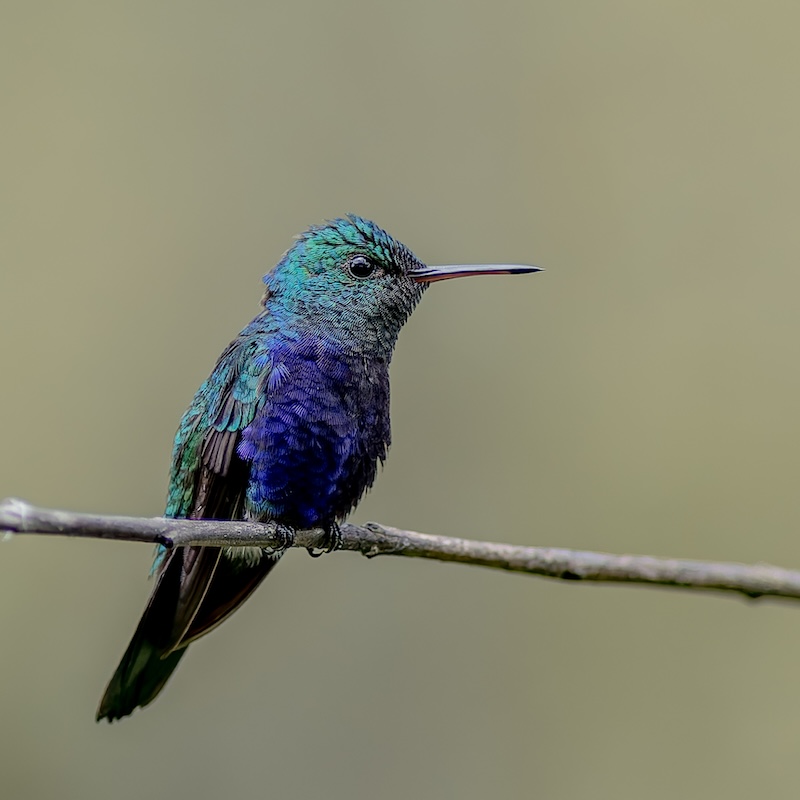
Hummingbird Species: Facts Worth Knowing
- During the day, hummingbirds can visit between 1,000-2,000 flowers, using their excellent memory to remember which flowers they have already visited and consuming roughly half their body weight in nectar and insects each day.
- Hummingbirds are known for their incredible agility, being the only birds that can fly forwards, backwards, hover mid-air, and even fly upside down, thanks to their unique wing structure and muscle adaptations. Unlike most birds, which tend to generate lift only on the downstroke, hummingbirds produce lift on both the upstroke and downstroke — a capability no other birds share.
- Some extreme high-altitude species, like the Ecuadorian Hillstar, will retreat into deep caves overnight to shield themselves from frost, snow, and wind.
- Andean hummingbirds have evolved special genetic mutations that alter their hemoglobin to bind and transport oxygen more efficiently than low-altitude species.
- The Giant Hummingbird is the largest hummingbird in the world, found across the Andes from low arid valleys up to elevations of 14,000 feet, and measuring up to 8 inches long..
- Hummingbirds are essential pollinators in the Eastern Andes, with many plants relying exclusively on these birds for reproduction.
- Many Andean flowers have evolved vivid red or orange tubular forms, shapes that hummingbirds can access with ease while reducing competition with insects.